



Raspberry Pi AI HAT+ 2
- Mã sản phẩm: Raspberry Pi AI HAT+ 2
- Nhà sản xuất: Raspberry Pi
- Website hỗ trợ: https://www.proe.vn
8.950.000₫
Unlock generative AI on your Raspberry Pi 5
Featuring the new Hailo-10H neural network accelerator, the Raspberry Pi AI HAT+ 2 delivers 40 TOPS (INT4) of inferencing performance, ensuring generative AI workloads run smoothly on Raspberry Pi 5. Performing all AI processing locally and without a network connection, the AI HAT+ 2 operates reliably and with low latency, maintaining the privacy, security, and cost-efficiency of cloud-free AI computing that we introduced with the original AI HAT+.
Unlike its predecessor, the AI HAT+ 2 features 8GB of dedicated on-board RAM, enabling the accelerator to efficiently handle much larger models than previously possible. This, along with an updated hardware architecture, allows the Hailo-10H chip to accelerate large language models (LLMs), vision-language models (VLMs), and other generative AI applications.
For vision-based models — such as Yolo-based object recognition, pose estimation, and scene segmentation — the AI HAT+ 2’s computer vision performance is broadly equivalent to that of its 26-TOPS predecessor, thanks to the on-board RAM. It also benefits from the same tight integration with our camera software stack (libcamera, rpicam-apps, and Picamera2) as the original AI HAT+. For users already working with the AI HAT+ software, transitioning to the AI HAT+ 2 is mostly seamless and transparent.
Off‑board tasks with on‑board RAM
With 8GB of dedicated on‑board RAM, the AI HAT+ 2 is ideal for running large language models (LLMs) and vision-language models (VLMs) locally and securely, leaving the host Raspberry Pi 5 free to handle other tasks and ensuring your AI models run smoothly.
A model for privacy and security
Delivering reliable, low-latency AI processing at the edge and without a network connection, the AI HAT+ 2 simplifies data security, minimises infrastructure requirements, and reduces cloud API costs.
Ready-made models
A set of sample models is provided by Hailo; users can also train custom vision models or fine-tune generative AI models to suit their application, such as speech to text, translation, or visual scene analysis.
All of the software for compatible generative AI models can be found in Hailo’s GitHub repo.
Specification
Hailo-10H AI accelerator delivering 40 TOPS (INT4) inferencing performance
Performance for computer vision models comparable to the Raspberry Pi AI HAT+ (26 TOPS)
Runs generative AI models efficiently using 8GB on-board RAM
Fully integrated into Raspberry Pi’s camera software stack
Conforms to Raspberry Pi HAT+ specification
Supplied with optional heatsink, and with 16mm stacking header, spacers, and screws to enable fitting on Raspberry Pi 5 with Raspberry Pi Active Cooler in place
Documents
Compliance
Raspberry Pi AI HAT+ 2 has undergone extensive compliance testing and meets a number of regional and international standards.
View and download relevant certificates and conformity documents.
Some example applications
The following LLMs will be available to install at launch:
| Model | Parameters/size |
| DeepSeek-R1-Distill | 1.5 billion |
| Llama3.2 | 1 billion |
| Qwen2.5-Coder | 1.5 billion |
| Qwen2.5-Instruct | 1.5 billion |
| Qwen2 | 1.5 billion |
More (and larger) models are being readied for updates, and should be available to install soon after launch.
Let’s take a quick look at some of these models in action. The following examples use the hailo-ollama LLM backend (available in Hailo’s Developer Zone) and the Open WebUI frontend, providing a familiar chat interface via a browser. All of these examples are running entirely locally on a Raspberry Pi AI HAT+ 2 connected to a Raspberry Pi 5.
The first example uses the Qwen2 model to answer a few simple questions:
The next example uses the Qwen2.5-Coder model to perform a coding task:
This example does some simple French-to-English translation using Qwen2:
The final example shows a VLM describing the scene from a camera stream:
Fine-tune your AI models
By far the most popular examples of generative AI models are LLMs like ChatGPT and Claude, text-to-image/video models like Stable Diffusion and DALL-E, and, more recently, VLMs that combine the capabilities of vision models and LLMs. Although the examples above showcase the capabilities of the available AI models, one must keep their limitations in mind: cloud-based LLMs from OpenAI, Meta, and Anthropic range from 500 billion to 2 trillion parameters; the edge-based LLMs running on the Raspberry Pi AI HAT+ 2, which are sized to fit into the available on-board RAM, typically run at 1–7 billion parameters. Smaller LLMs like these are not designed to match the knowledge set available to the larger models, but rather to operate within a constrained dataset.
This limitation can be overcome by fine-tuning the AI models for your specific use case. On the original Raspberry Pi AI HAT+, visual models (such as Yolo) can be retrained using image datasets suited to the HAT’s intended application — this is also the case for the Raspberry Pi AI HAT+ 2, and can be done using the Hailo Dataflow Compiler.
Similarly, the AI HAT+ 2 supports Low-Rank Adaptation (LoRA)–based fine-tuning of the language models, enabling efficient, task-specific customisation of pre-trained LLMs while keeping most of the base model parameters frozen. Users can compile adapters for their particular tasks using the Hailo Dataflow Compiler and run the adapted models on the Raspberry Pi AI HAT+ 2.
Điện tử ProE cung cấp linh kiện điện tử, thiết bị điện tử , linh kiện IoT chính hãng. ProE cung cấp dịch vụ đặt hàng linh kiện điện tử, thiết bị điện tử chính hãng theo yêu cầu cụ thể của khách hàng. Liên hệ : contact@proe.vn, SĐT: 0938946849
Website: www.proe.vn
Diễn đàn: https://www.facebook.com/groups/278263459284765/
Youtube Chanel: ProE Youtube
Facebook: ProE Facebook
Sản phẩm cùng loại

Raspberry Pi 5
3.950.000₫

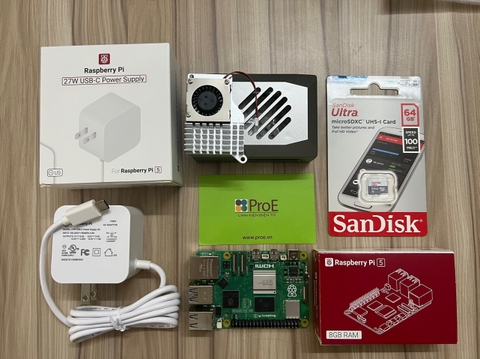

Combo Raspberry Pi 5 Case A
Liên hệ

Raspberry Pi AI Kit
3.990.000₫

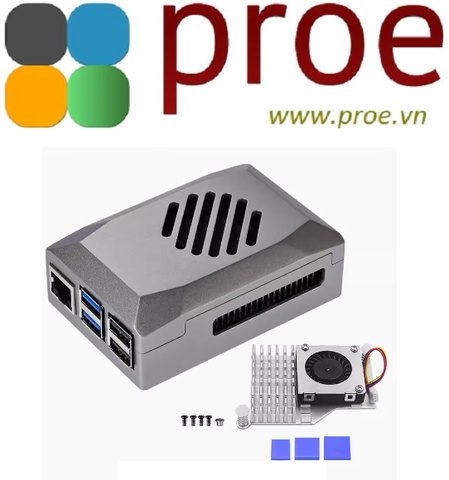
Vỏ ABS RPI 5 kèm PWM FAN
490.000₫

Raspberry Pi 5 Silver ABS Case
320.000₫


